
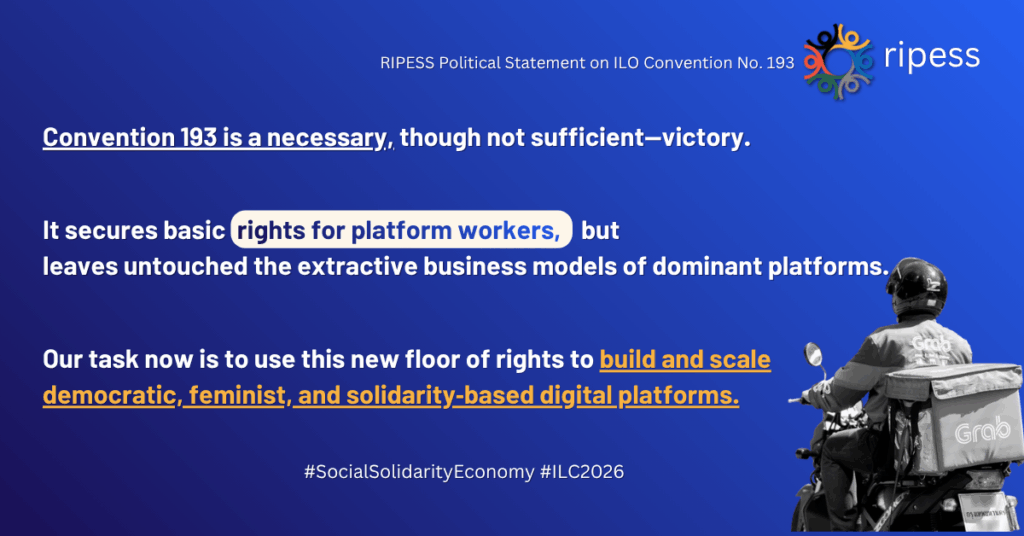
On 12 June 2026, the International Labour Conference adopted ILO Convention No. 193, the first global treaty establishing binding labour standards for platform work. This is a historic victory for platform workers worldwide and for the many organisations that have long challenged the false narrative that digital innovation must come at the expense of labour rights.
Convention 193 confirms a fundamental principle: workers managed through apps, ratings systems and opaque algorithms are workers — entitled to rights, protections and dignity. It establishes an essential floor of rights within a platform economy still dominated by extractive business models.
The Convention was not adopted unanimously. Two governments voted against (United States and New Zealand) and eleven abstained. This makes the next phase even more crucial: defending this achievement, pushing for rapid ratification and implementation, and campaigning in countries that opposed or abstained, especially in tech‑dominant economies.
Why Convention 193 Matters
Convention 193 closes a major gap in global labour governance by addressing working conditions in a sector that has expanded rapidly while evading clear legal obligations. It covers key areas at the heart of platform workers’ struggles: pay, safety and health, social security, algorithmic management and correct classification.
The Convention requires governments to ensure that workers are classified based on the reality of their work, not on contractual labels chosen by platforms. It applies to both formal and informal workers, and to both in‑person and online tasks — from delivery and transport to data labelling and content moderation. This broad scope prevents companies from escaping regulation by shifting categories or geographies.
What Workers Gain
Convention 193 establishes a meaningful baseline of rights, including:
- Freedom of association and collective bargaining
- Non‑discrimination and elimination of forced and child labour
- Safe and healthy working conditions
- Timely payment, transparent deductions and minimum wage protection for employees
- Compensation for work‑related expenses
- Access to social security on equal terms with other workers
One of its most significant advances is the recognition that algorithmic management is a labour issue. Workers gain the right to information about automated systems, explanations of significant automated decisions, and human review of suspensions, deactivations or non‑payment.
The Convention also strengthens protections for migrant and refugee workers, requiring governments to prevent abusive recruitment, debt bondage and unsafe conditions.
Limits and Next Steps
Convention 193 binds states, not companies. Its impact will depend on national implementation, enforcement and the capacity of workers’ organisations to use it in collective bargaining, litigation and public pressure. The absence of a complementary Recommendation — expected but not finalised — leaves implementation guidance incomplete and politically contested.
This gap is also an opportunity. The ILO’s active role within the UN Inter‑Agency Task Force on Social and Solidarity Economy (UNTFSSE) and the UN General Assembly resolutions on SSE (2023 and 2024) provide a strong institutional basis for future standard‑setting. A Supplementary Recommendation should explicitly recognise worker‑owned, cooperative and solidarity‑based platform models, and call on Member States to support them through procurement, digital infrastructure and financing.
A Political Message for Allies and Movements
Convention 193 ends the fiction that digital labour exists outside labour rights. It affirms that technological intermediation cannot be used as a loophole to deny fair pay, social protection, safety, due process or collective voice.
For labour, feminist, migrant justice, digital rights, food sovereignty and climate justice movements, the Convention creates common ground. It links struggles against precarity, opaque algorithms and extractive data governance with the fight for democratic control over digital infrastructures.
The central question is no longer whether platform work should be regulated, but what kind of digital economy we want: one that remains extractive and corporate‑controlled, or one accountable to workers, communities and the public good.
The Next Horizon: A Digital Solidarity Economy
Convention 193 must be read alongside the 2022 ILO Resolution on Decent Work and the Social and Solidarity Economy, which established the first internationally agreed definition of the SSE. Together, these instruments provide a roadmap for democratic, participatory and worker‑centred digital systems.
A digital solidarity economy means:
- Supporting worker‑owned and community‑based platforms
- Advancing cooperative data governance
- Designing public policies that favour socially useful digital infrastructures
- Embedding participation, transparency and accountability into technology itself
This agenda is especially relevant in sectors central to RIPESS work — care, food systems, local services and territorial economies — where platformisation is reshaping livelihoods and access to markets.
RIPESS Contribution to This Process
RIPESS has played a sustained role in bringing the Social and Solidarity Economy into the ILO agenda:
- 2025: launching Reclaiming the Platform Economy through Social Solidarity, advancing the call to democratise digital labour;
- 2026: calling for explicit recognition of worker‑owned and cooperative platform models, and urging Member States to support them through procurement, digital infrastructure and financing.
This trajectory converges in Convention 193, which creates a regulatory baseline that strengthens the viability of SSE‑based digital platforms and reinforces the case for democratic alternatives.
Priorities for Action
- Ratification and implementation: press governments to ratify Convention 193, align national laws and involve workers’ organisations in oversight.
- Ambitious national rules: classification, social protection, algorithmic transparency, human review and remedies for wrongful deactivation.
- Digital system change: use procurement, local development, social finance and innovation funding to support platform cooperatives and SSE initiatives.
- A Supplementary Recommendation: explicitly recognise SSE platforms and provide concrete guidance for Member States.
- A shared narrative: position Convention 193 as a workers’ victory and a foundation for a just digital transition rooted in solidarity.
Conclusion
Convention 193 is both an achievement and an invitation. It strengthens the legal and political basis to defend platform workers today, while sharpening the case for a digital solidarity economy tomorrow. The challenge now is to ensure that this historic treaty becomes not the ceiling of ambition, but the floor from which deeper transformation begins.
Full Statement Available
Read, download and share the complete RIPESS Political Statement. The document includes the full analysis, political positioning and our proposals for action.