
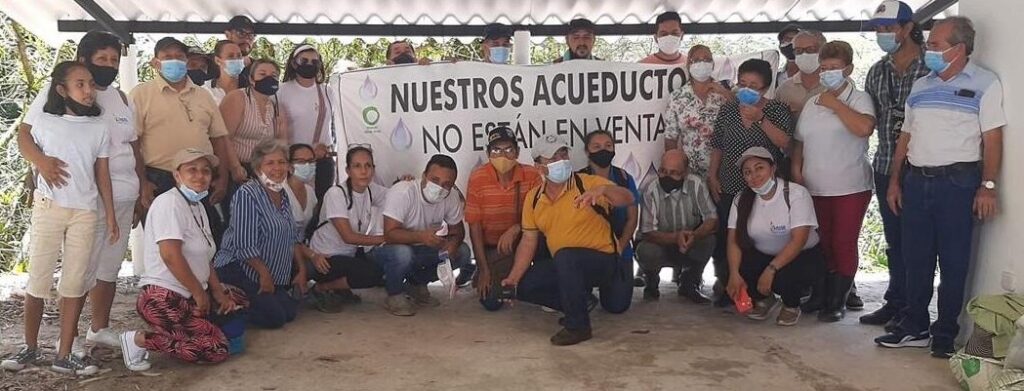
Community aqueduct meeting held as part of Community Water Management Day. Photo: courtesy of ACER Agua Viva
Artice by Sandra Moreno, executive secretary ofRIPESS.
Water is more than just a resource: it is the principle that sustains all forms of life. Wherever it flows, lands, crops and communities flourish. And where it is lacking, migration, inequality and the loss of sovereignty begin. That is why, every 22 March — International Water Day — we remember that defending water is defending life itself. At RIPESS, the Intercontinental Network for the Promotion of the Social and Solidarity Economy, we affirm that water cannot be treated as a commodity or subjected to the logic of profit. Its management requires democratic, community-based, cooperative and deeply territorial models; models that already exist and are sustained thanks to the collective action of thousands of rural, peasant, Black, Indigenous, Raizal and grassroots communities that self-manage this common good.
Between 24 and 28 February, we took part in the second international conference on rural reform and rural development, ICARRD+20, in Cartagena, Colombia. As part of this conference, the Forum: “Water and Agrarian Reform, Water Justice for Life and Total Peace” was held, providing a space for dialogue and collective development of the Water as a Common Good Strategy. At this forum, various experiences were shared, such as the more than 32,000 community water systems in Colombia, serving as a living example that a model different from the corporate-commercial one is possible. These organisations, managed by local people from within the territories, have been key political actors in the defence of water and the continued presence of small farmers in the territories. Their struggle has achieved historic advances: the participatory drafting of Decree 0960, article by article alongside the communities at the Dialogue Table, and the approval in the fourth reading of the specific law for community water systems. Both these achievements are not merely regulatory but express the recognition of a model and its managers as strategic allies for food sovereignty, agrarian reform and the democratisation of the commons. Because without water, there is no possibility of inhabiting the territories or guaranteeing a dignified life. Where there is community-managed water, there is local power, autonomy and the capacity to influence policy.
Caring for water is caring for the land
Unlike extractive models that deplete rivers and aquifers, community water systems protect the ecosystems of the water cycle. Their environmental sustainability is not limited to managing a service: it involves safeguarding water sources, reforestation, monitoring and halting exploitation licences that threaten life. In regions such as the Magdalena Medio in Colombia, where a century of oil exploitation has transformed an agri-food basket into a vulnerable territory, communities point out that megaprojects not only consume enormous quantities of water, but return it polluted, causing damage that is often irreversible.
Elsewhere, such as on the island of Tierra Bomba, south of the city of Cartagena de Indias, the struggles continue. There, Black, Raizal and Palenquero communities defend their ancestral relationship with water, mangroves and small-scale fishing.
Despite the fragmentation of the territory and the absence of effective state policies, they have created their own systems for collecting, distributing and caring for water. They do so with wisdom, recognising that water cannot be separated from the territory, nor sovereignty from dignity.
We at RIPESS were also supporting students from the Liceo de Bolívar school, alongside the team from the Ministry of Housing, City and Territory and Deputy Minister Ruth Quevedo, in the creation of a participatory water map of their territory to highlight its importance and learn how to defend water strategically. Institutions play a fundamental role in rebuilding the territory, reorganising public policies around water, and harmonising the coexistence of communities with nature.
These processes show us that true water management begins with the recognition of communities as water managers, not as passive users or service recipients, and that they are the ones who carry out genuine democratic water management and who, as political actors, elevate water to a common good of strategic interest to the nation.
In the face of imposed logics that view water through the prism of profitability and competition, there is an urgent need for new agreements to regulate this essential resource based on solidarity, equity and sustainability. Tariff systems must recognise the social and environmental value of water, and the role of those who care for it. The social solidarity economy invites us to understand water as a space for democratic self-management and cooperation, where relationships between people, communities and nature are rebuilt.
Defending water on these grounds means defending the most fundamental principles of life: the right to live with dignity, to decide on the use of the land, and to build a fairer and more sustainable shared future. This 22 March, we celebrate and honour those who, day in, day out, ensure that water continues to flow: the organised communities that care for it, manage it and defend it as a common good and as life itself.
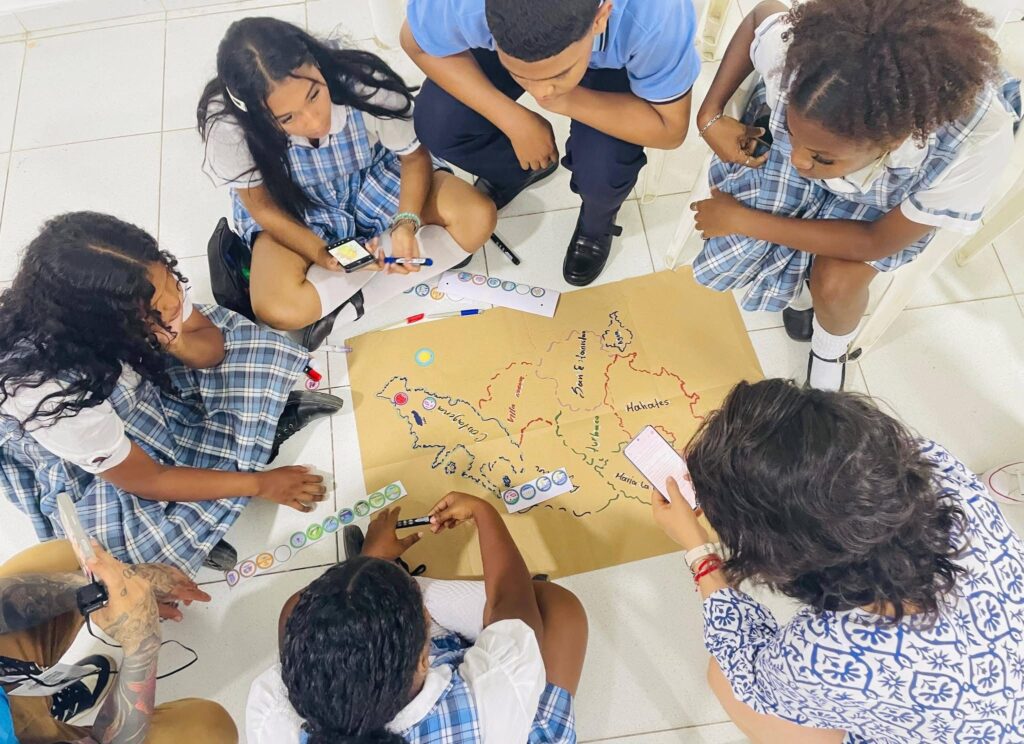
Students from the Liceo de Bolívar school creating a participatory water map of their territory. Photo: Sandra Moreno