RIPESS will participate in the 2026 ECOSOC Forum on Financing for Development Follow‑Up (FfD Forum), taking place on 20–24 April 2026 at UN Headquarters in New York. This year’s Forum is especially significant, following the momentum generated by the landmark Fourth International Conference on Financing for Development (FfD4) held in June, where the Sevilla Commitment recognized the Social and Solidarity Economy (SSE) for the first time in the global FfD agenda.
Throughout the FfD4 process, RIPESS and its members played a leading role, co‑leading a global advocacy effort that contributed decisively to achieving this historic milestone.
From Recognition to Implementation
The adoption of UN General Assembly Resolutions 77/281 and 79/213 marked a historic milestone: the Social and Solidarity Economy (SSE) is now formally recognized as a key contributor to sustainable development. Both resolutions call on Member States to strengthen financing, support and capacity‑building for cooperatives, associations and solidarity‑based enterprises.
The Sevilla Commitment advanced this recognition within the Financing for Development (FfD) agenda, particularly through:
- Paragraph 32(h): encouraging tailored financial and non‑financial support for SSE entities.
- Paragraph 21: placing SSE and cooperatives alongside MSMEs in the global financing architecture.
Yet the follow‑up process reveals a clear imbalance. While MSMEs benefit from detailed operational guidance on access to finance, enabling environments and regulatory frameworks, SSE is referenced only briefly, despite facing many of the same structural challenges. Many of the measures proposed for MSMEs are equally relevant and urgently needed for SSE actors, including:
- strengthening local and community banks, national development banks and credit unions
- improving financial infrastructure
- addressing unintended regulatory barriers
- adapting macroprudential and tax regulations that currently disadvantage cooperative and solidarity‑based finance
To ensure that global commitments translate into real impact for communities and territories, countries need SSE‑specific intermediary financing mechanisms. These mechanisms should be capable of pooling resources from multilateral development banks, public development banks, ODA, philanthropy and domestic budgets, and channeling them to grassroots initiatives through adapted instruments, democratic governance models and appropriate time horizons.
RIPESS will share its Working Paper “Financing the Social and Solidarity Economy: Democratic Intermediary Mechanisms to Realise UN Commitments” (updated in April 2026) that outlines how these UN recommendations to finance SSE can reach the grassroots in the most effective and democratic ways possible, through a generic intermediary organizational approach that supports SSE ecosystems development at the national and territorial levels. The document addresses the need to bridge the efforts of MDBs and other PDBs coalescing around the Finance in Common Summits (FiCS) movement to align with the SDGs on the one hand, and UN recommendations calling for these institutions to support SSE as a means of contributing to the realization of the SDGs on the other.
Only by moving from recognition to implementation can the SSE be fully integrated into the FfD agenda—with the level of detail, ambition and resourcing needed to scale its transformative potential.
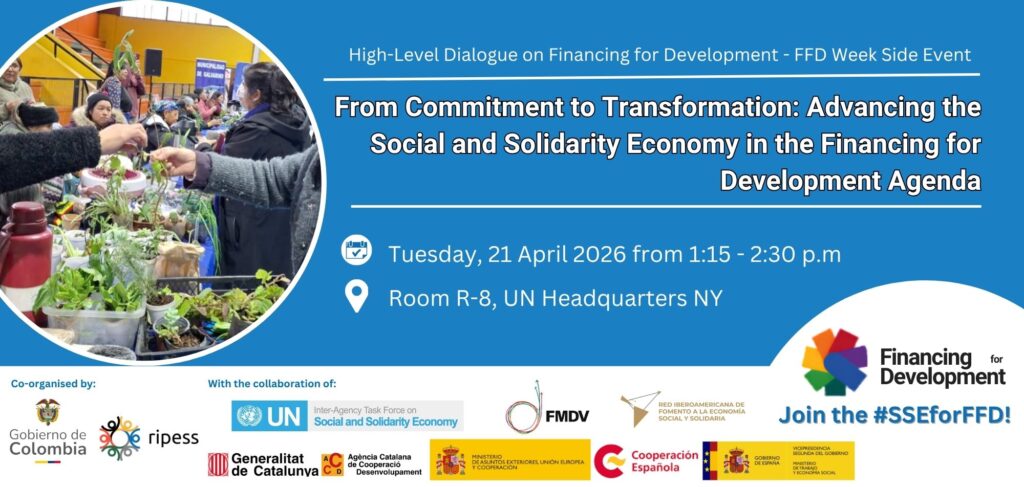
RIPESS at FfD Week: Our collective Side Event
During FfD Week in New York, RIPESS will co‑organize the event:
“From Commitment to Transformation: Advancing the Social and Solidarity Economy in the Financing for Development Agenda”
📅 Tuesday, 21 April 2026
🕐 1:15–2:30 p.m.
📍 UN Headquarters, Room CR‑8, New York
Co‑organized by:
The Ministry of Foreign Affairs and the Administrative Department of Social Prosperity of Colombia, and RIPESS
In collaboration with:
Ministry of Labour and Social Economy of Spain, Ibero‑American Network of Governments for the SSE (RIFESS), Global Fund for Cities Development (FMDV) and UN Inter‑Agency Task Force on the SSE (UNTFSSE)
Introduction and moderation:
- Andrew Allimadi, Social Affairs Officer, United Nations Department of Economic and Social Affairs (UN DESA)
Speakers:
- Mauricio Rodríguez, Director of the Department for Social Prosperity of Colombia and Executive Coordinator of the Ibero-American Network for the Promotion of the Social and Solidarity Economy
- Sergio Colina Martín, Director-General for Sustainable Development Policies (DGPOLDES), Ministry of Foreign Affairs, European Union and Cooperation of Spain
- Sandra Moreno Cadena, Executive Secretary, Intercontinental Network for the Promotion of the Social and Solidarity Economy (RIPESS)
- Ignacio Corlazzoli, Manager of Resource Mobilization and Global Partnerships, CAF – Development Bank of Latin America and the Caribbean
- Carlos de Freitas, Executive Director, Global Fund for Cities Development (FMDV)
- Epiphania Rwodzi, Programme Management and Portfolio Officer, Local2030 Coalition
Our Key Political Asks for the FfD Outcome Document
RIPESS will present a concise set of proposals for Member States and stakeholders, including:
- Integrating SSE systematically into all MSME‑related recommendations, ensuring parity in ambition and detail.
- Recognizing and resourcing SSE‑specific intermediary financing mechanisms that can channel resources to grassroots actors.
- Addressing regulatory, macro‑financial and tax barriers that disproportionately affect SSE and cooperative finance.
- Strengthening national FfD strategies and international cooperation frameworks to include SSE as a pillar of democratic and sustainable development.
About the Financing for Development Process
The FfD agenda is the UN’s central framework for shaping how sustainable development is financed at global, regional and national levels. It covers public and private resource mobilization, debt sustainability, international tax cooperation, trade, systemic issues and the role of development banks.
The FfD Forum is the annual intergovernmental platform that monitors progress and advances policy recommendations. Each year, FfD Week brings together governments, UN agencies, financial institutions, civil society and global networks to debate how resources are mobilized and allocated — and which economic models receive support to scale.
Decisions taken in this space directly influence whether financing reaches communities and territories, and whether transformative approaches such as the SSE can thrive.