To mark International Care and Support Day (29 October), the RIPESS Intercontinental Gender Commission is joining #VoicesOfCare, the collective campaign launched by the Global Care Alliance, of which RIPESS is a member. The campaign aims to raise awareness of the experiences of those who provide and receive care, and to promote fairer, more inclusive and sustainable care systems.
RIPESS’s contribution highlights a reality that is often overlooked: global care chains, which shift care responsibilities between regions and fall particularly on migrant women, domestic workers, community carers and communities in the Global South.
From global care chains to alternatives based on solidarity
Through testimonies from women in different regions of the world, the campaign shows how inequalities in the organisation of care affect millions of people and how the Social Solidarity Economy (SSE) is already building concrete alternatives to put life at the centre.
Among the initiatives highlighted are care co-operatives, community networks, women’s associations and other collective initiatives that demonstrate that it is possible to organise care in a fairer, more democratic and more sustainable way.
🎥 Video | Transforming global care chains through the SSE
A campaign built on the voices of those who care
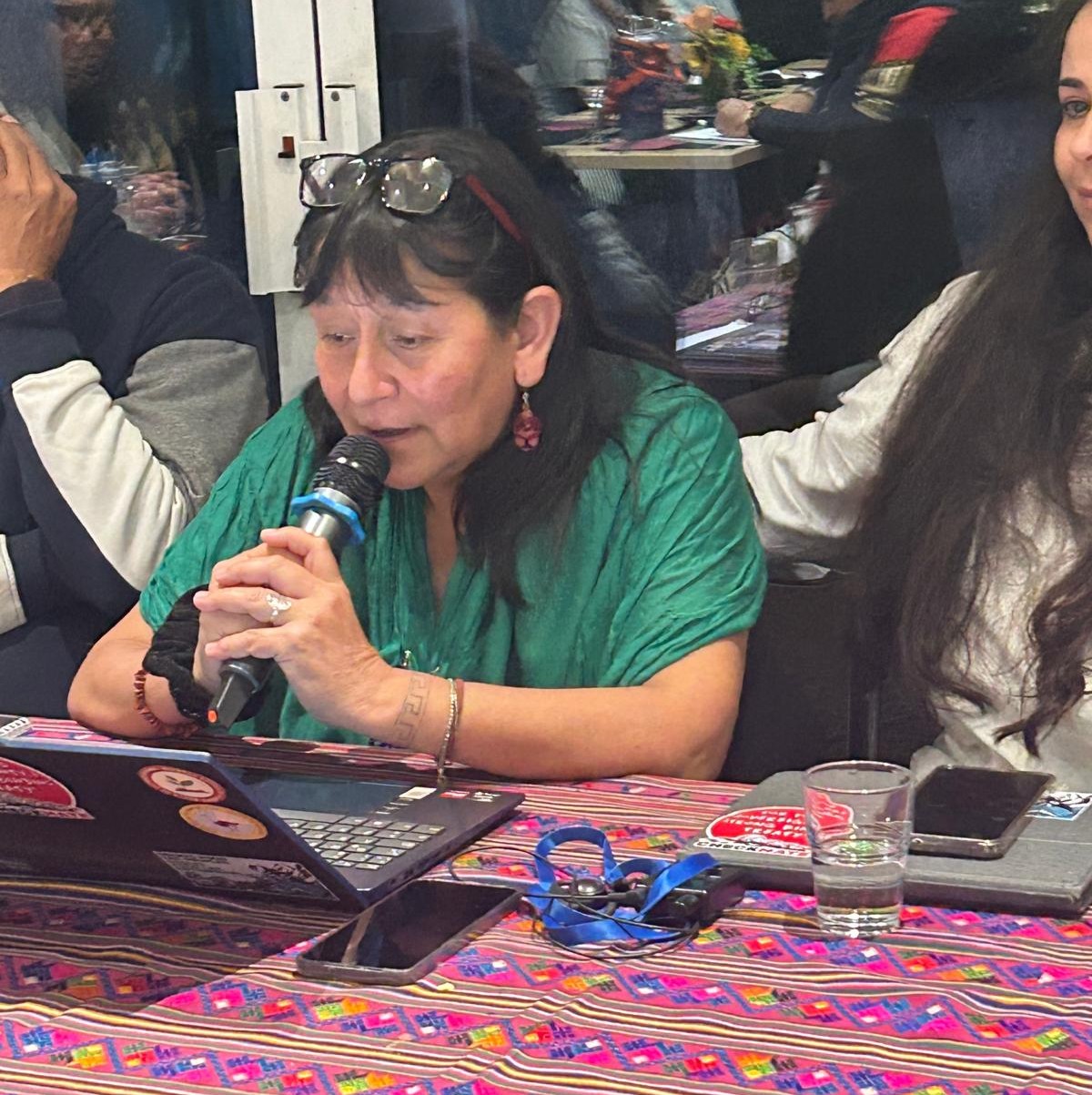
To mark International Care and Support Day, women from Social Solidarity Economy organisations in Spain, Guatemala, Cameroon, Indonesia and Turkey share their experiences of global care chains and the alternatives already being built at grassroots level.
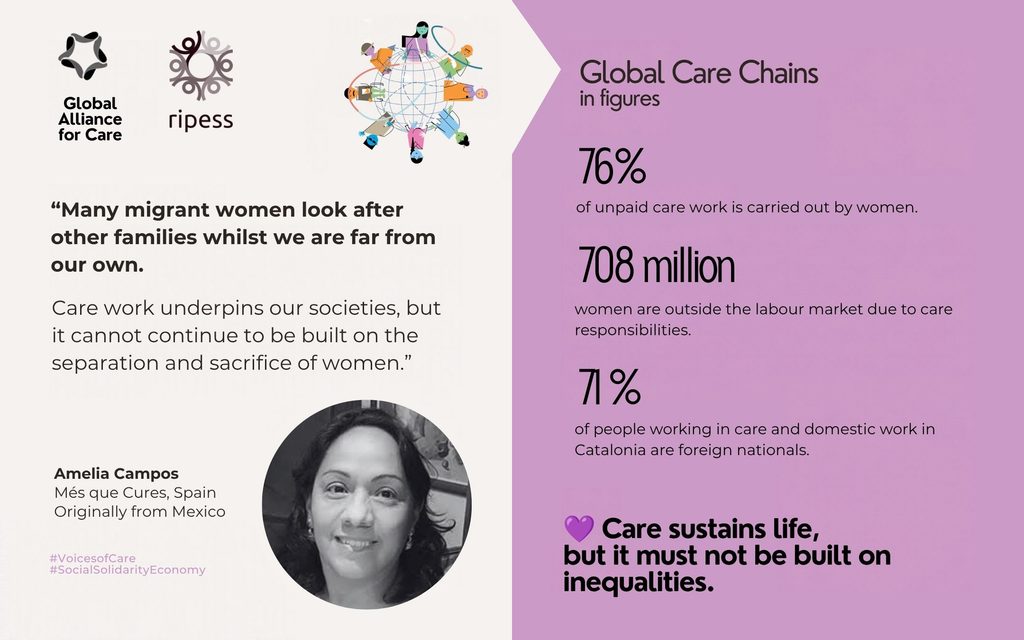
Amelia Campos, Més que Cures, Spain. Originally from Mexic
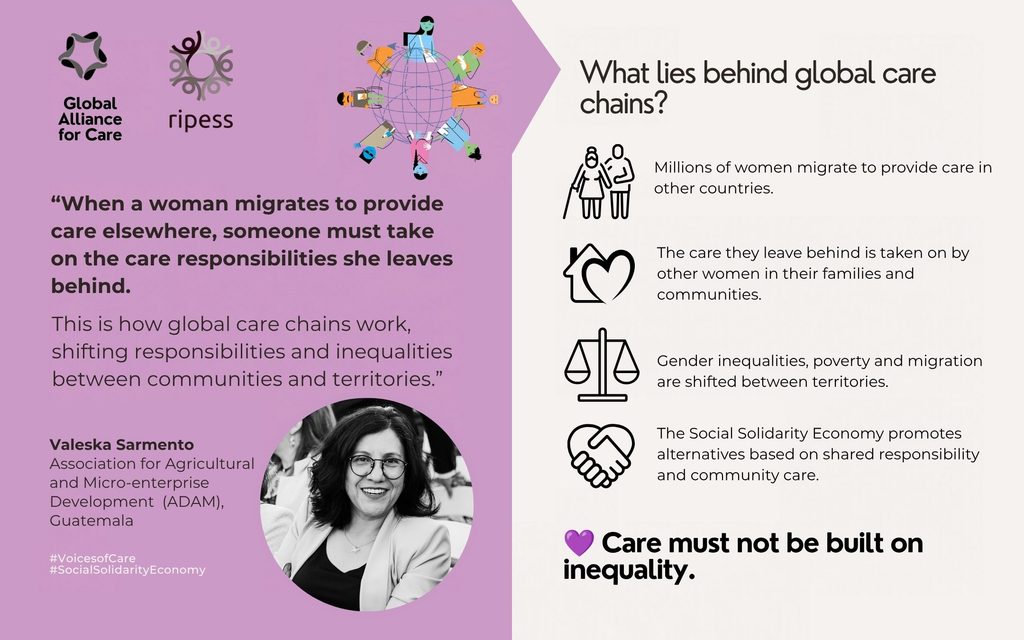
Valeska Sarmento, Association for Agricultural and Micro-enterprise Development (ADAM), Guatemala
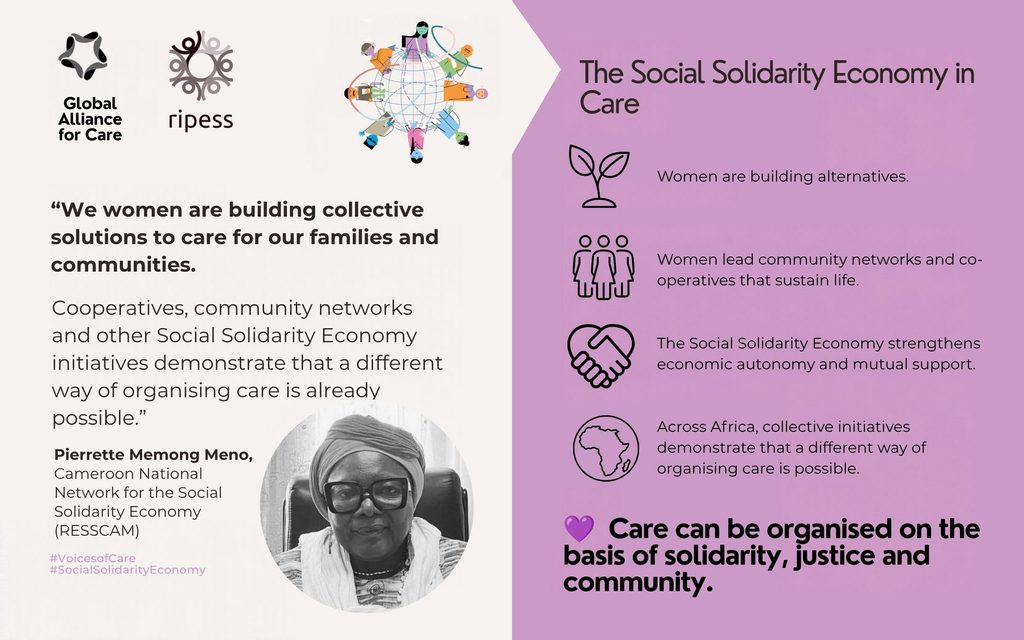
Pierrette Memong Meno, National Network for the Social and Solidarity Economy of Cameroon (RESSCAM)
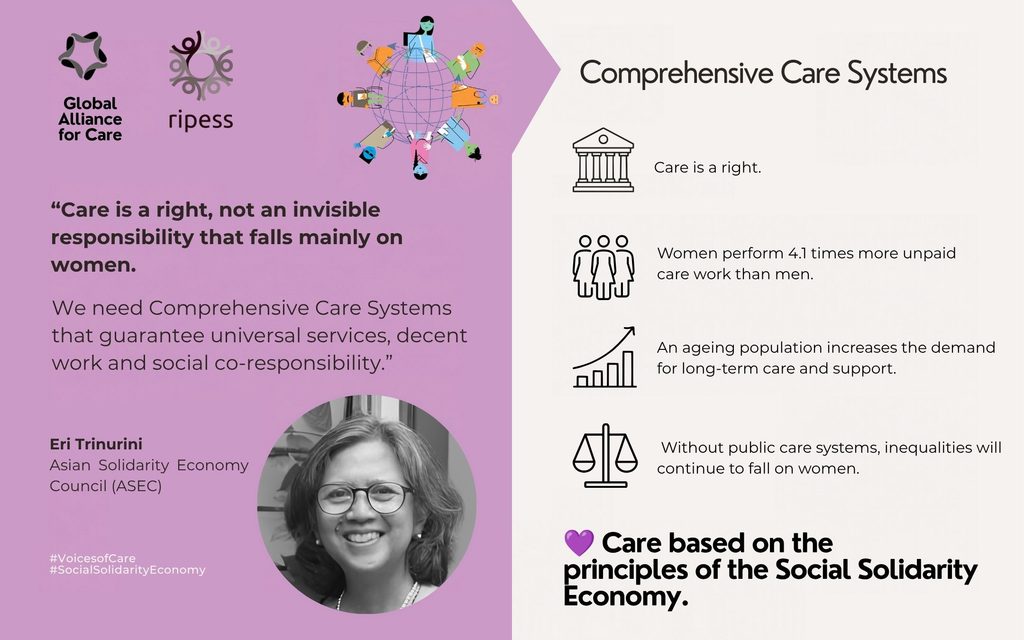
Eri Trinurini, Asian Solidarity Economy Council (ASEC), Indonesia
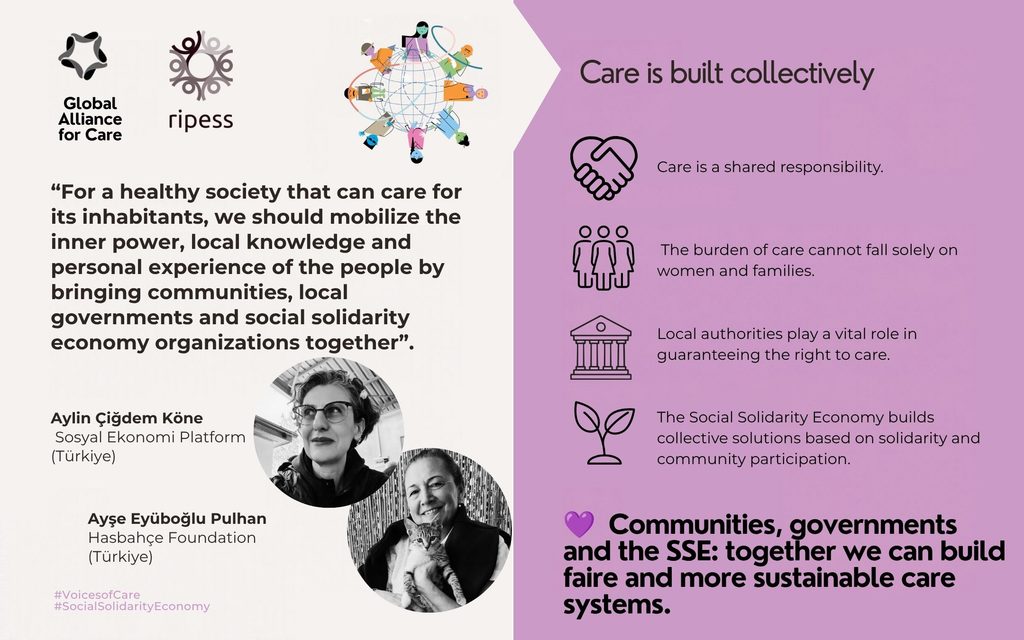
Aylin Çiğdem Köne – Social Economy Platform, Turkey and Ayşe Eyüboğlu Pulhan – Hasbahçe Foundation, Turkey
Why talk about global care chains?
Care work, both human and ecosystem-based, continues to be characterised by patriarchal, racist and classist relationships that perpetuate structural inequalities worldwide. Historically, many of these tasks have been rendered invisible, left unpaid or carried out under precarious conditions.
According to the International Labour Organisation (ILO), women carry out 76.2 per cent of unpaid care work worldwide and devote 3.2 times more time than men to these activities. Furthermore, 708 million women are outside the labour force due to unpaid care responsibilities.
As Oxfam points out, sustaining life and our economies relies on global care chains: transnational networks through which care responsibilities are transferred between women in different territories and social positions.
In practice, as the Inter-American Development Bank (IDB) points out, millions of people, mostly women, migrate to carry out care work. In doing so, they often delegate the care of their own households to others, creating networks that transcend borders. These dynamics stem both from the growing demand for care in destination countries and from factors such as poverty, a lack of opportunities and other structural inequalities in countries of origin.
In this way, global care chains can shift responsibilities onto other women, families and communities, reproducing inequalities across different territories. Migrant women and domestic workers are particularly vulnerable to situations of job insecurity, informal employment and a lack of social protection.
In this context, discussing care also means discussing labour rights, migration, gender, social justice and the sustainability of life.
Faced with this reality, organisations, cooperatives and networks within the Social Solidarity Economy are promoting alternatives that place care at the centre, fostering models based on solidarity, shared responsibility, dignity at work, democratic participation and social justice.
Our call to action
At RIPESS, we call on governments to recognise care as a fundamental human right and to move towards comprehensive care systems that are universal, public, community-based and gender-sensitive, recognising and strengthening the role of the Social Solidarity Economy in the provision and organisation of care.
Because care sustains life. And transforming care means transforming our societies.
💜#VoicesOfCare #SocialSolidarityEconomy