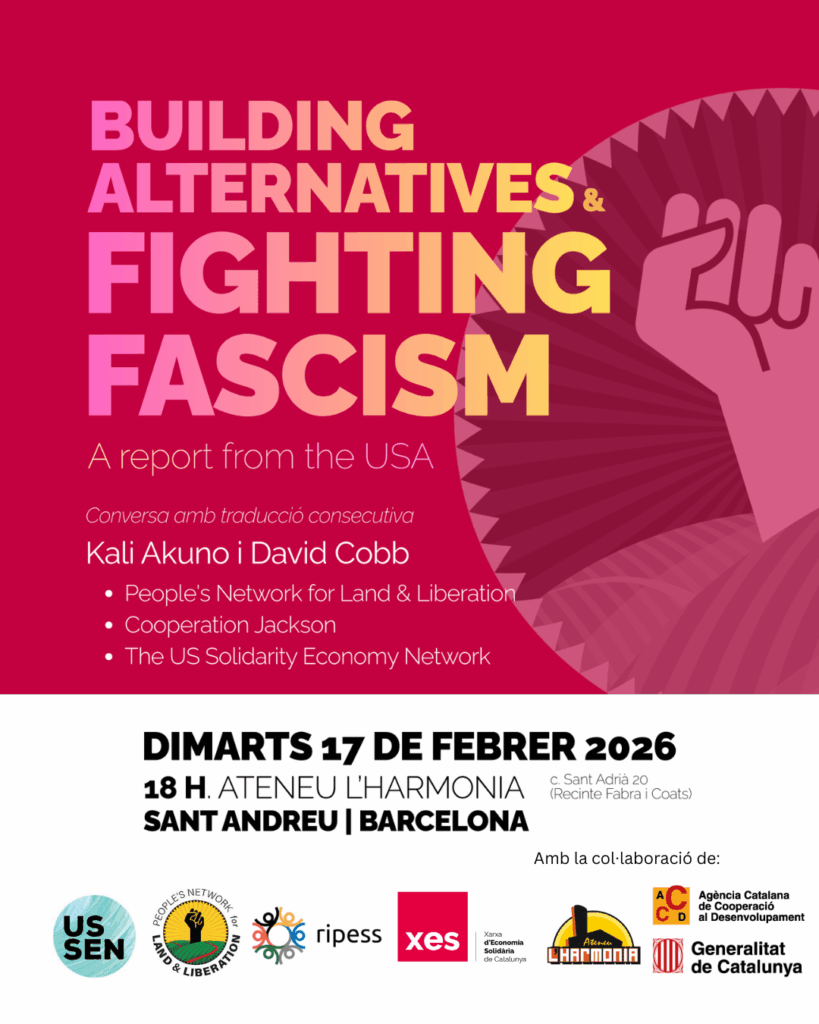
Next Tuesday, February 17, 2026, at 6 p.m. at Ateneu L’Harmonia (Sant Andreu, Barcelona), the event “Building alternatives and fighting fascism. A report from the USA” will take place—an international dialogue space to reflect on current challenges in the United States and the responses being built by social movements and organizations, such as the Social and Solidarity Economy (SSE).
The event is co-organized by the U.S. Solidarity Economy Network (USSEN), XES (Xarxa d’Economia Solidària), the People’s Network for Land & Liberation, and RIPESS, and will feature the participation of Kali Akuno and David Cobb, two key figures of the U.S. SSE with extensive experience in building economic and political alternatives rooted in local territories.
Building while resisting
In a global context marked by the rise of authoritarian forces, the worsening ecological collapse, and deep economic transformations, the SSE in the United States continues to build concrete alternatives while confronting the growth of fascism.
The Trump phenomenon should not be understood as an isolated event but as a symptom of a deeper structural crisis. Capitalism may be undergoing a mutation toward forms of “techno-feudalism,” driven by automation and the extreme concentration of technological and financial power. In historical moments of major transition—such as the shift from agrarian to industrial economies in the 1930s—fascism emerges as an authoritarian response to uncertainty. Today, amid another systemic transformation, it once again becomes a latent threat.
In response, the proposal is not merely defensive. The U.S. SSE promotes a clearly post-capitalist framework that advocates for regenerative economic systems, the recovery of community knowledge predating settler colonialism, and a political economy based on solidarity, democracy, and territorial rootedness.
Plural strategy and territorial construction
Far from a single roadmap, the approach promoted by these networks is strategic and pluralistic.
Among the highlighted initiatives is the People’s Network for Land & Liberation (PNLL), whose mission is to decommodify land in order to restore a right relationship with it and with all our relatives and communities. Its goal is to promote democratic ownership of the means of production and liberatory social relations.
Based on this mission, the PNLL advances six areas of action:
- Decommodification of land, promoting agroecological production and the recovery of traditional ecological knowledge.
- Decommodification of housing, as a right and a common good.
- Feminist democracy, not only as a principle but as a concrete organizational practice.
- Community centers for popular production.
- Political education and transformative pedagogy.
- Art and culture as cross-cutting pillars, understanding art as a fundamental vehicle for social change.
These experiences show that, even in an adverse context, the construction of alternatives is real, territorial, and collective.
A gathering to strengthen global alliances
The presence of Kali Akuno and David Cobb in Barcelona is an opportunity to bring experiences closer together, share learnings, and reinforce international alliances within the global solidarity economy network. The event will include consecutive English–Catalan interpretation and is open to anyone interested in building economic, democratic, and community-based alternatives.
David Cobb is co-coordinator of the U.S. Solidarity Economy Network, a member of RIPESS North America, and co-coordinator of the Board of RIPESS Intercontinental. Kali Akuno is a key reference in building community power and cooperative economics in the U.S. South, especially through initiatives such as Cooperation Jackson.
The conversation will include consecutive interpretation from English to Catalan.
🗓 Tuesday, February 17
⌚️ 6 p.m.
📌 Ateneu l’Harmonia (c. Sant Adrià 20, Recinte Fabra i Coats, Barcelona)
An open invitation to those who wish to learn, debate, and strengthen the alternatives already underway, connecting struggles and constructions from the local to the international.