
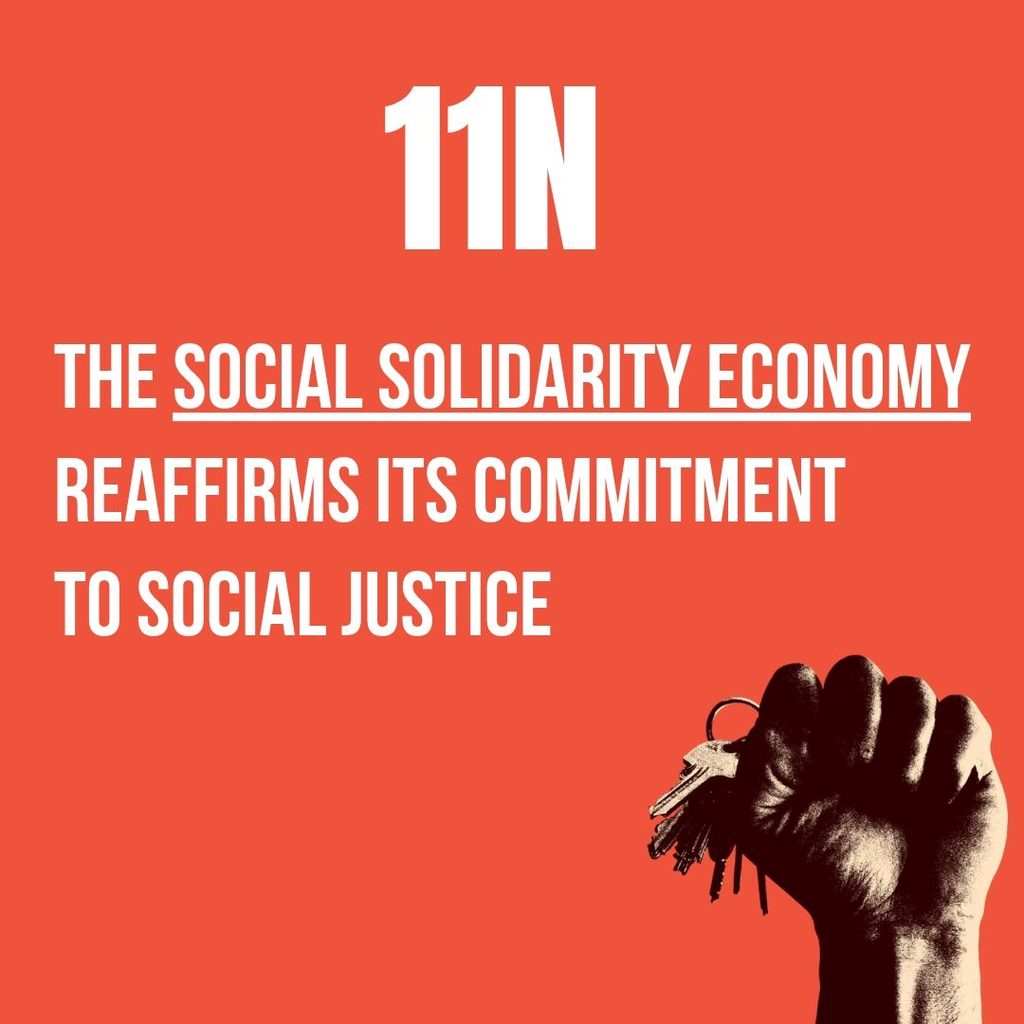
In light of the general strike called for 11 November by trade unions and social movements campaigning for the right to housing, we at RIPESS (Intercontinental Network for the Promotion of the Social and Solidarity Economy) wish to reaffirm our commitment to an economy that guarantees a dignified life for all people.
From the various regions where the Social Solidarity Economy (SSE) is active, we observe with concern the worsening of problems affecting millions of people: the difficulty in accessing adequate housing, the rising cost of living, job insecurity, growing inequalities and the commodification of essential areas such as care, food and the very right to housing itself.
These realities are not confined to any one country or region. They form part of global dynamics that highlight the limitations of an economic model centred on the accumulation of profits at the expense of collective well-being and the sustainability of life.
In response to this, the Social Solidarity Economy has been building concrete alternatives for decades. Cooperatives, mutual societies, associations, social enterprises, ethical finance initiatives, agroecological projects, community care and housing networks, as well as numerous examples of democratic economic models, demonstrate every day that another way of producing, consuming, working and organising ourselves is possible.
The Social Solidarity Economy (SSE) maintains that housing should be a right and not a speculative asset. Similarly, it asserts that work must guarantee decent living conditions, that care work must be recognised and collectively supported, and that the economy must serve people and local communities.
We therefore consider it essential to move towards public policies that guarantee universal access to housing, strengthen public services, promote decent work, recognise the care economy and foster the development of economic initiatives geared towards the common good. It is equally necessary to promote regulatory, fiscal and financial frameworks that enable the growth of SSE organisations and other non-speculative economic models.
At RIPESS, we also wish to highlight the importance of alliances between the Social Solidarity Economy, movements for the right to housing, trade unions, community initiatives and organised youth. The current challenges require collective responses capable of bringing together social justice, economic democracy and ecological sustainability.
In this context, we endorse the position expressed by REAS Red de Redes, a member of RIPESS and a leading organisation in the Social Solidarity Economy in Spain, which has publicly declared its support for the general strike and for the demands aimed at guaranteeing the right to housing, decent work and fair living conditions for the entire population.
The experience of our networks in Africa, Latin America and the Caribbean, Asia, Europe, North America and Oceania confirms that real and viable alternatives do exist. Every Social Solidarity Economy initiative demonstrates that it is possible to build economies based on cooperation, democracy, equity and respect for the planet’s limits.
In the face of a crisis that undermines fundamental rights, we reaffirm our commitment to building societies where housing, work, care and economic participation serve life rather than profit.
RIPESS Intercontinental Secretariat
Intercontinental Network for the Promotion of the Social Solidarity Economy