
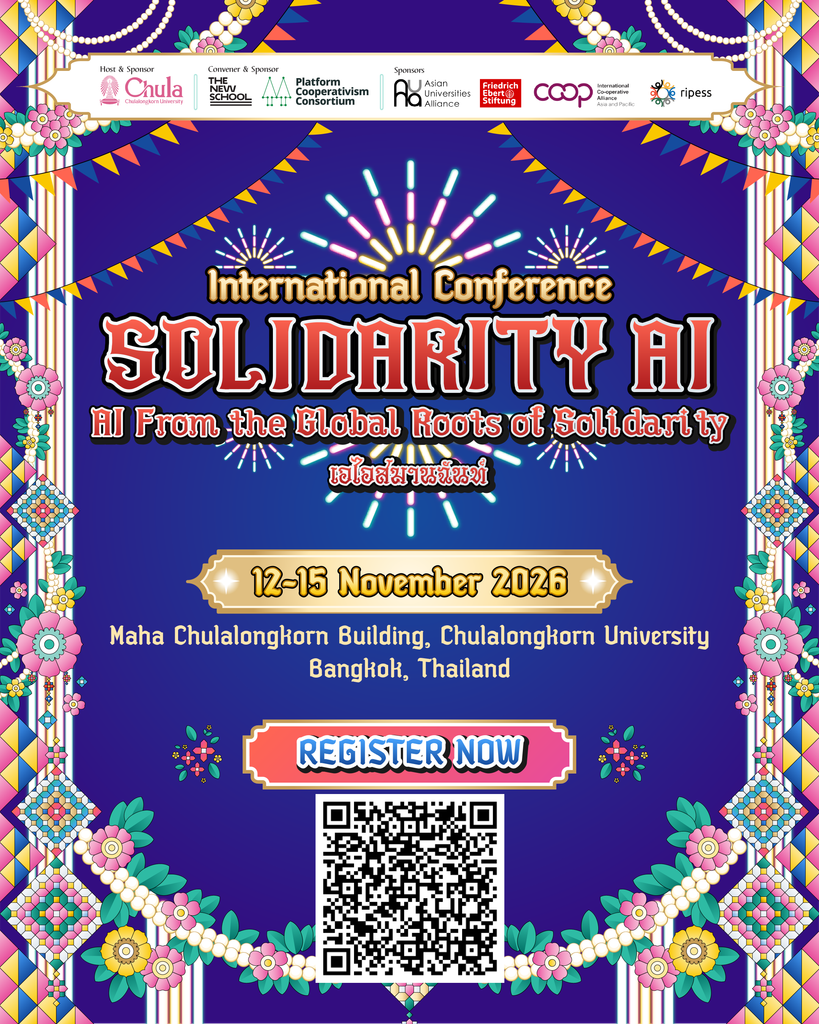
12–15 November 2026 | Chulalongkorn University, Bangkok, Thailand
Who should own, govern and benefit from artificial intelligence? How can digital technologies be developed in ways that serve people and communities rather than reinforce corporate power and extractive economic models?
These questions will be at the heart of Solidarity AI 2026 Conference, taking place from 12 to 15 November at Chulalongkorn University in Bangkok, Thailand. The conference will bring together researchers, cooperative leaders, workers, AI developers, activists, feminist and disability rights advocates, policy researchers and community organizations to explore how artificial intelligence can be shaped around solidarity, collective ownership and democratic governance.
RIPESS will participate through its Executive Secretary, Sandra Moreno Cadena, alongside other members and people connected to its global network, contributing perspectives and experiences from the social solidarity economy (SSE) movement.
Convened by the Platform Cooperativism Consortium Global (PCC Global), PCC Thailand and Chulalongkorn University, in partnership with regional allies, the conference builds on the discussions initiated at the previous year’s gathering in Istanbul. This edition places particular emphasis on experiences from Asia and the Global South, exploring how workers and communities can shape the technologies that increasingly influence their lives and livelihoods.
Bringing the social solidarity economy perspective to AI
For RIPESS, the development of artificial intelligence raises fundamental questions about economic democracy, ownership, participation and the distribution of power. As digital technologies increasingly shape working conditions, access to services and everyday life, workers and communities must be recognized not merely as users or sources of data, but as active decision-makers.
The social solidarity economy offers important perspectives and experiences for building alternatives based on cooperation, collective ownership, democratic governance, care and territorial development. These principles can help shape digital infrastructures and AI systems that respond to social and ecological needs rather than profit-driven interests.
Contributions from RIPESS and its wider network
The conference will feature contributions from several people connected to RIPESS and its wider network, bringing together perspectives from different regions and areas of work:

Sandra Moreno Cadena, Executive Secretary of RIPESS, will bring the perspective of the global social solidarity economy movement, focusing on community ownership, democratic governance, care, ecological transition and territorially rooted networks.

Shigeru Tanaka, former Co-global Coordinator of RIPESS and member of the Fair Finance Guide Japan coalition, will examine the financial structures behind the expansion of digital platforms in Asia and their impacts on workers.

Akkanut Wantanasombut, a member of RIPESS and researcher with the Research Group in Innovation for Social Solidarity and Inclusive Economy in Asia (RIPESS ASEC), Institute of Asian Studies, Chulalongkorn University, will contribute to discussions on solidarity ecosystems, community-led digital initiatives and democratic governance.

Bronwen Morgan, representing RIPESS Oceania, the New Economy Network Australia (NENA) and UNSW Sydney, will bring a perspective on the role of legal frameworks in shaping non-extractive platform economies, with a focus on place, care and solidarity.
Taking part in the conference programme
Their contributions will be spread across several sessions throughout the conference:
12 November | How the Solidarity AI Conference Came Together (8:45–9:00 am)
Opening session | Hall of Intania, Faculty of Engineering
Akkanut Wantanasombut will introduce the story behind the conference, together with Ronnakorn “Ronnie” Vaiyavuth of the Chulalongkorn School of Integrated Innovation. Their presentation will also explore how Thai communal traditions, including temple fairs and kriab glass mosaics, have inspired the conference’s visual identity and its vision of technology built collectively by and for communities.
12 November | Building a Solidarity AI Economy (1:15–2:45 pm)
Concurrent Session 4 – Workshop | Room 205, Maha Chulalongkorn Building
Sandra Moreno will join Uygar Özesmi, James Farrar and Recep Erdem Cansızoğlu in a workshop exploring what it would take to build AI infrastructures governed by communities and workers rather than extractive platforms.
Drawing on the social solidarity economy perspective, Sandra will address how community ownership, democratic governance, care, ecological transition and territorially rooted networks can shape digital infrastructure and AI, ensuring that emerging economic alternatives do not reproduce extractive platform models.
12 November | Social Solidarity Economy & Cooperative Movements Meet AI (2:45–3:30 pm)
Concurrent Session 8 – Short presentations and audience discussion | Room 111, Maha Chulalongkorn Building
Shigeru Tanaka will examine the regional impacts of Japanese investment in Asia’s digital economy. Drawing on his work with PARC and the Fair Finance Guide Japan coalition, he will explore the investment structures behind the expansion of platform applications across Asia and their links to the exploitation of platform workers. His contribution will raise questions about what a solidarity-based digital economy would demand from the financial actors behind these platforms.
13 November | Mapping the Solidarity Ecosystem: NeedsMap & ThaiEconomap (10:40 am–12:10 pm)
Concurrent Session 2 – Collaborative Mapping | Room 111, Maha Chulalongkorn Building
Akkanut will join Ali Ercan Özgür, Shaunette Ferguson and Anyamitra “Yanagi” Wongprasitthiporn in a collaborative session exploring how digital infrastructures can strengthen local solidarity.
Through the examples of NeedsMap, a platform cooperative coordinating community needs and resources, and ThaiEconoMap, a platform mapping local businesses and SMEs, participants will identify connections, gaps and opportunities across solidarity ecosystems. The session will explore how mapping can strengthen community-owned and locally governed infrastructures.
14 November | Unconference Session (9:45–10:25 am)
Facilitated by Akkanut Wantanasombut | Hall of Intania, Faculty of Engineering
Akkanut will facilitate an open session in which participants collectively set the agenda, propose topics and questions, and form small discussion groups. This participatory format will create space for emerging ideas, collaborative exploration and new connections following the first days of the conference.
14 November | Situated Resistance to Extractive AI (11:15 am–12:00 pm)
Concurrent Session 1 – Reverse Panel | Room 105, Maha Chulalongkorn Building
Sandra Moreno will moderate this panel exploring how resistance to extractive AI emerges from the experiences of workers and communities whose knowledge, labour and data are being captured. The discussion will examine alternatives based on consent, collective ownership, democratic governance and shared benefits.
14 November | Who Gets to Shape AI? (11:15 am–12:00 pm)
Concurrent Session 4 – Reverse Panel | Room 205, Maha Chulalongkorn Building
Bronwen Morgan will contribute to this panel exploring who gets to influence the development and governance of AI.
Her contribution will focus on how the legal foundations of non-extractive platform economies can reshape platform structures and value flows, placing care and territorial contexts at the centre. She will explore the role of legal frameworks in building solidarity infrastructures across communities, while also considering their limitations.
14 November | Full-Stack Sovereignty & Democratic Governance (2:15–3:00 pm)
Concurrent Session 6 – Reverse Panel | Room 111, Maha Chulalongkorn Building
Sandra Moreno and Akkanut Wantanasombut will join Recep Erdem Cansızoğlu, Uygar Özesmi and Robin Puga in a discussion on digital sovereignty and democratic governance.
The session will explore how communities can exercise control over the different layers of AI infrastructure, including data, computing resources, models, identity and governance. It will examine alternatives based on distributed accountability and community ownership rather than the concentration of power in a handful of corporations.